
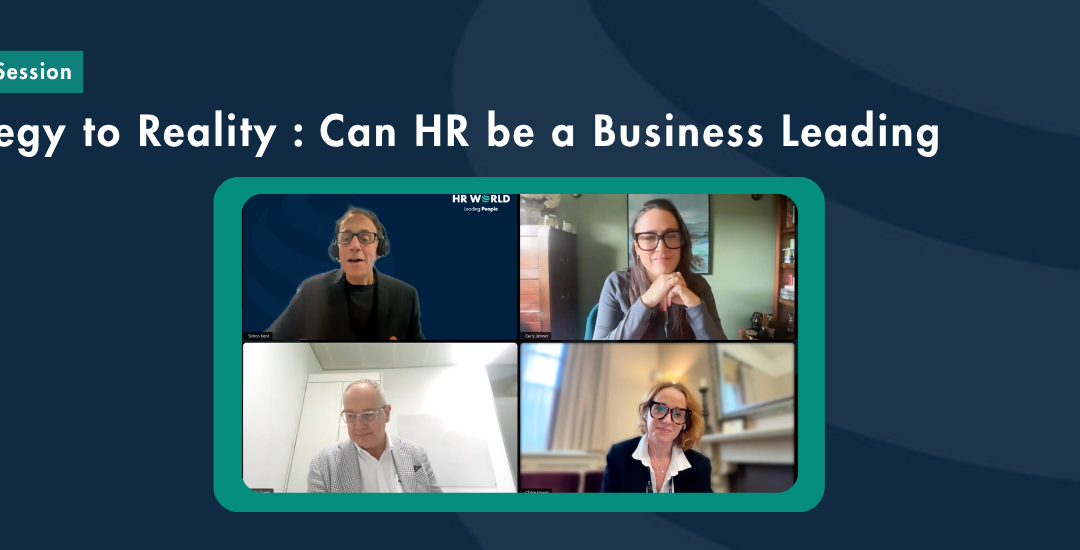
In an Insight Session from The HR World and sponsored by Ciphr, three leading HR professionals debated Strategy to Reality: Can HR be a Business Leading Function?
Bringing together Carly Jenner, Senior Vice President, Legal & People at Apeel Sciences and Claire Hawes, Ciphr’s own Chief Operating Officer and former CPO and Kevin Green, Chief People Officer, First Bus and formerly part of the leadership team that turned around the fortunes of Royal Mail, the session is well worth a look for ideas and inspiration for increasing your HR work and worth and making HR an integral part of every business going forward.
The Insights Session is well worth a view and is on demand here. Meanwhile, Claire Hawes and Carly Jenner tackle two other questions related to subject we didn’t have time to cover on the day:
Q: How can HR measure its own effectiveness in influencing strategy?
Claire Hawes: The simplest test for me is - are you in the room when decisions are made, or told afterwards and asked to “sort the people bit”? If it’s the latter, you’re implementing strategy, not influencing it.
To measure it, look back at the last year of exec agendas and count how many big decisions had people input from the start. Track what happened to your proposals…did they get funded, adopted, or quietly parked? Link your data to what the business cares about. “Attrition is 18%” gets a nod. “Attrition in our customer teams is 18% and those accounts show the highest churn risk” gets a conversation. And just ask your exec colleagues each quarter: “Did HR help you make a better decision?” Vague answers tell you plenty, and drill down into that in understanding how HR could have helped more.
Carly Jenner: Personally, I think one of the biggest indicators is whether HR is being brought into conversations early and willingly, aka before something becomes an HR issue. It's about looking at the decisions we're being asked to influence, how significant they are in shaping the direction of the business, and whether we have the credibility and confidence to challenge the thinking behind them. And ultimately, can we see the impact of our contribution in the decisions being made and the outcomes the business achieves?
Q: Do you think HR is becoming a profession of choice - rather than something people 'fall into’ - and if so will contributing to strategy make the role more attractive?
Carly Jenner: I think HR is becoming a more attractive career because of the opportunities to influence business strategy being broader than ever. But I also think we need to encourage HR professionals to be genuinely curious about other functions, understand how they operate, the challenges they face and how they contribute to the business. I'd love to see more people moving between HR and other functions, bringing different experiences and perspectives. Ultimately, the future shouldn't just be about developing better HR professionals, but better business leaders with deep expertise in people.
Claire Hawes: Short answer, yes. People used to fall into HR through office management or admin - now they’re choosing it, coming in as graduates or moving across from data, finance and ops. And I’d argue strategy is a big part of the appeal. Nobody gets excited about being the policy police, but seeing your work change how a business performs is a different story. I spent 20 years in HR before becoming COO, and that background is exactly what makes me so effective now.
My advice is to get commercial. Learn to read a P&L, spend time with your customer teams, and find out what worries your CEO. If you lead an HR team, bring your people into business reviews and cross-functional projects so they grow into the people the business wants in the room.